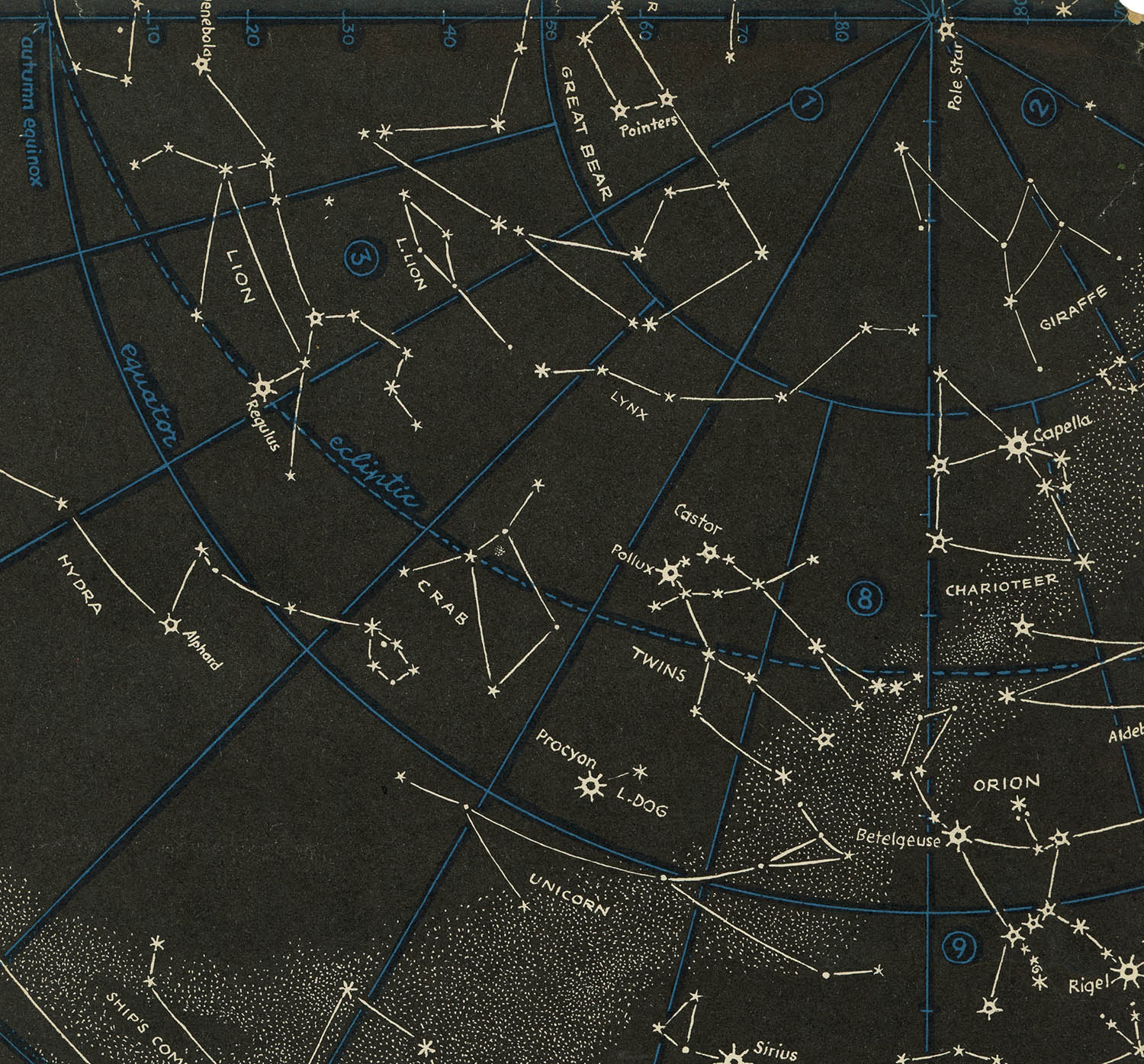
Detail, General Chart of the Sky
The Stars: A New Way to See Them
H. A. Rey
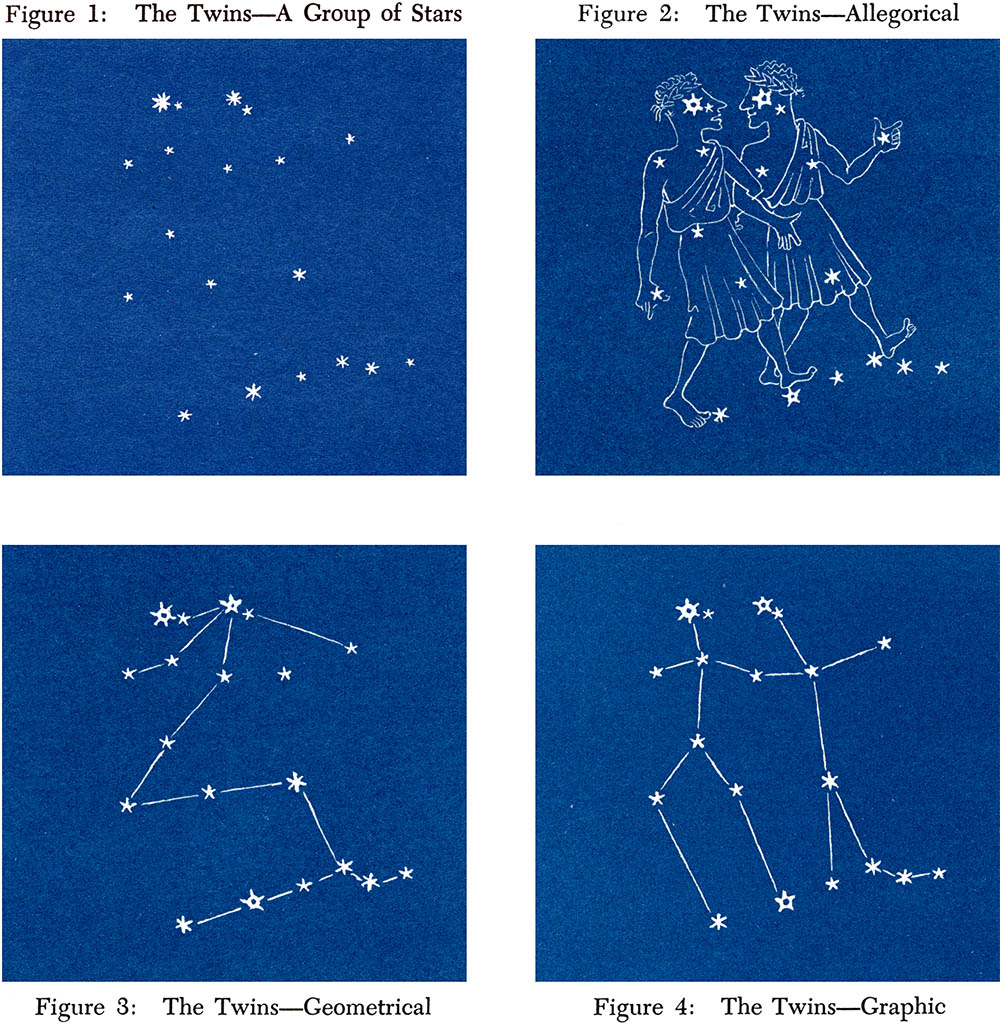
H. A. Rey was life-long amateur astronomer and by the 1950s he began experimenting with simplified methods to learn the constellations. He substituted the sometimes arbitrary traditional representations of constellations with diagrams that actually (or at least more closely) depicted the name. As he lated said: “All I did was try various connecting lines between the stars of a group until I got the shape which made sense. What surprises me is that nobody has done it before. The basic idea is so simple!” Here is Rey’s example for Gemini (the Twins):
Hans Augusto Reyersbach (16 Sep 1898—26 Aug 1977), later shortened to just H.A. Rey, was born in Hamburg, Germany. After his education at the Wilhelm Gymnasium and infantry service in WWI, he supported himself as a lithographer and designer of circus posters. In 1926 he moved to Rio de Janeiro to work for an import-export firm selling bathtubs. It was here that he met his wife, the artist and copywriter, Margarete Elisabeth Waldstein (or Margaret Rey).1
After their marriage in 1935 they honeymooned in Paris and settled in Montmartre where they illustrated and published several children’s books. Because they were Jewish they fled to Orléans in Jun 1940, just ahead of the Nazi occupation of Paris. They obtained a Brazilian visa and returned to Rio de Janeiro and travelled on to New York.
Of the few possessions they carried with them was a manuscript for a children’s book that would become Curious George. First published by Houghton Mifflin in 1941, the series became one of the most widely known and loved children’s series of all time. Between 1941—1966 the Reys’ published seven Curious George titles, with Margaret writing the story and Hans doing the illustrations. Although Margaret later stated that “We worked very closely together and it was hard to pull the thing apart.”
The astronomy book, however, appears to have been a solo project based on Hans’ long time passion of the subject.
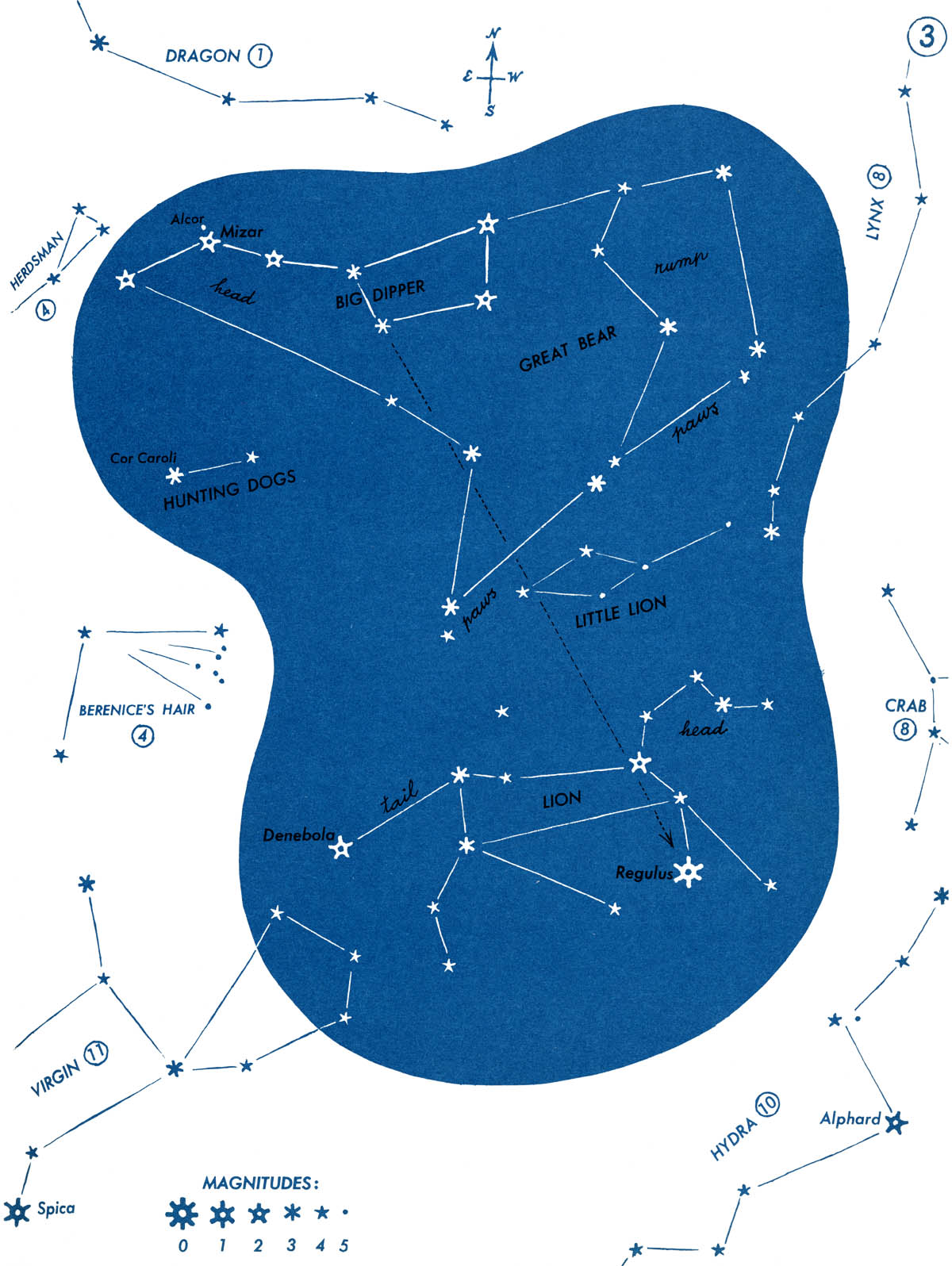
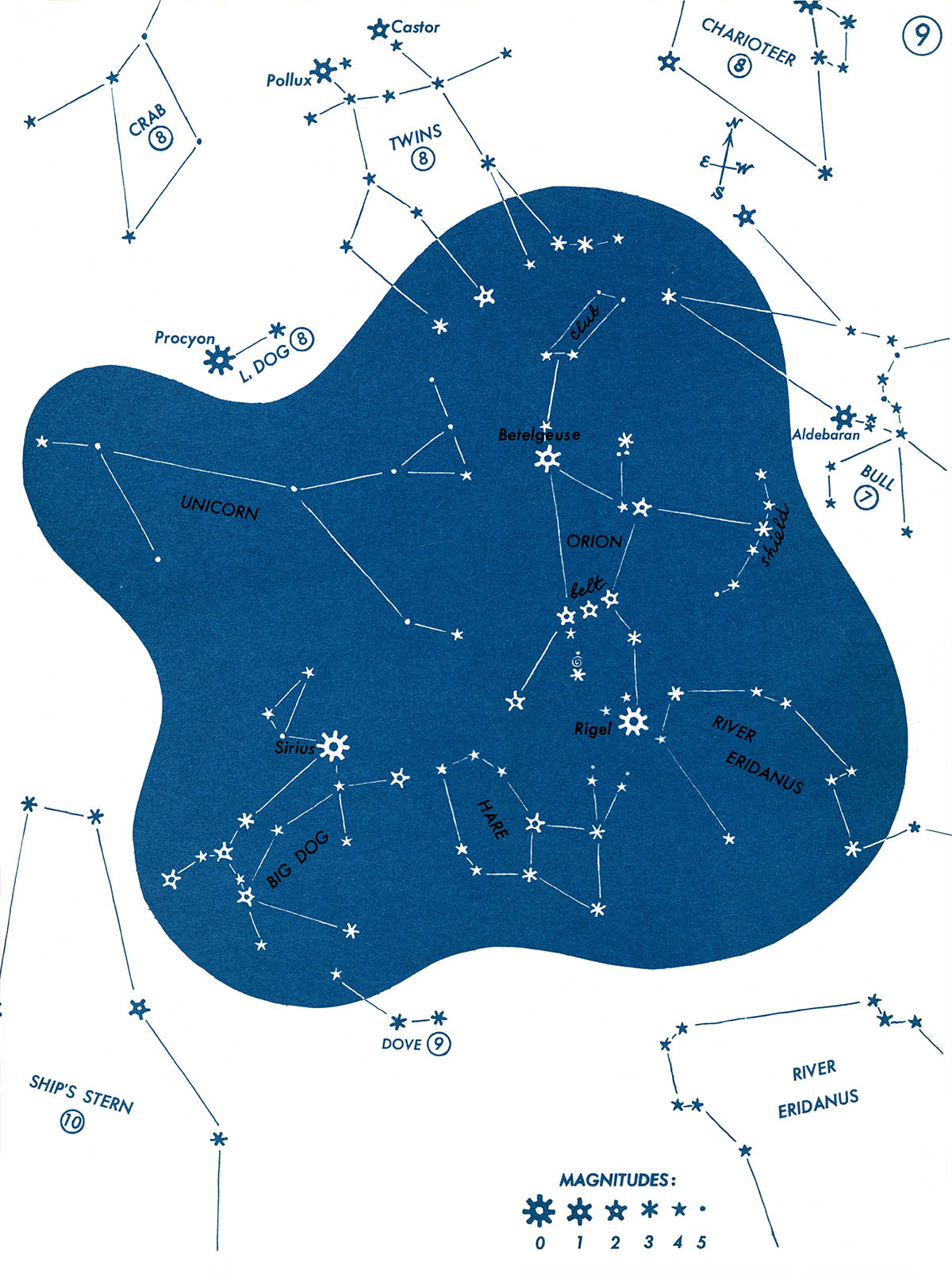
Constellation charts
The book, The Stars: A New Way to See Them2 uses Rey’s disarmingly simple illustrations to show his new constellation diagrams. As the Saturday Review commented in 1952: “The Stars is the best book available for its purpose. It is also a brilliant example of the combined use of art and writing in bringing science to the layman.”
Indeed, Rey’s style and tone bely the sophistication of his diagrams. Its not hard to find more complicated star charts, but you will be hard-pressed to find more useful ones. The book is now widely considered a classic and has been routinely recommended to beginners by professional astronomers from more than 50 years. The IAC still use his diagrams.
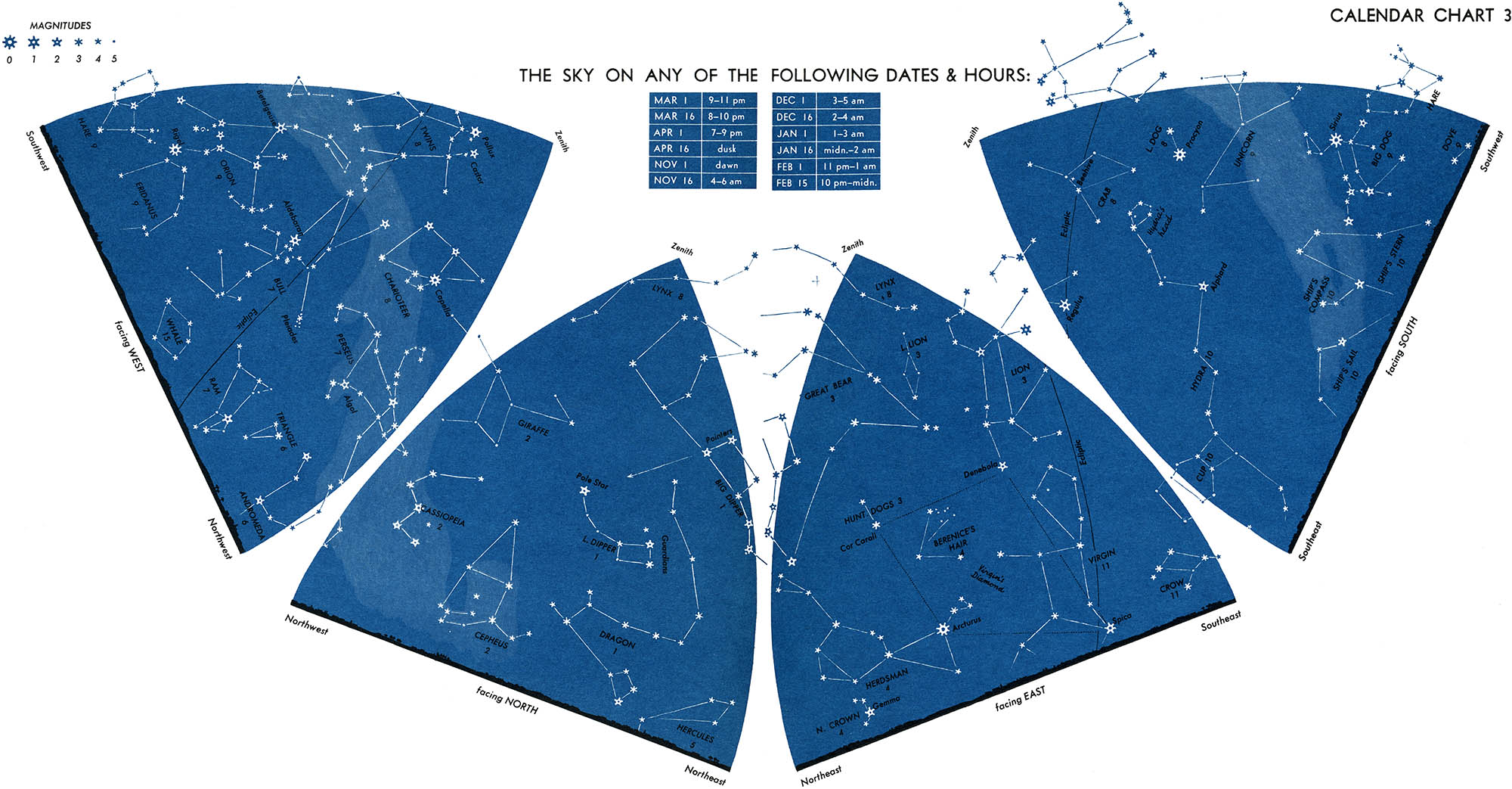
Calendar chart, first edition
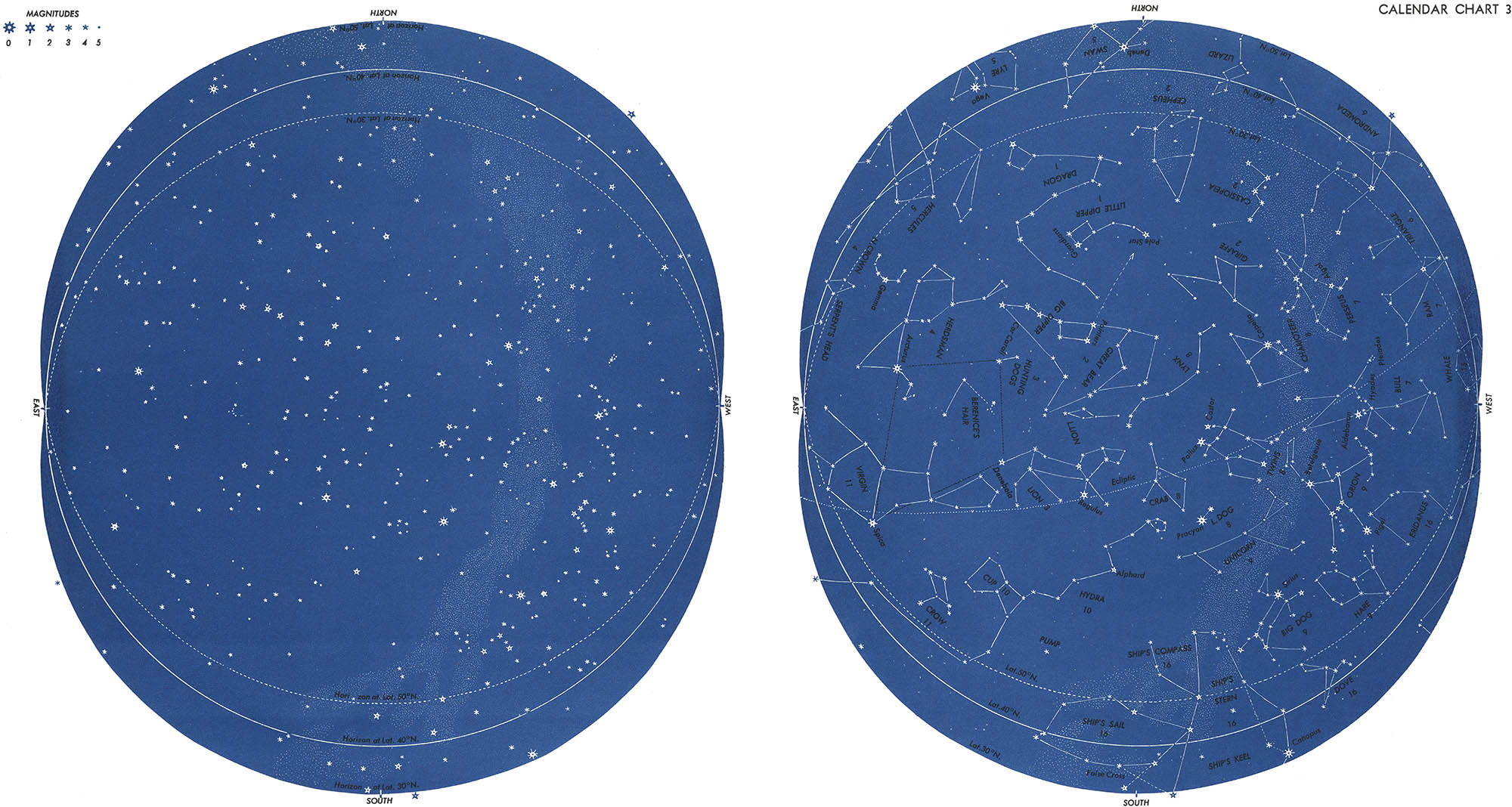
Calendar chart, second edition
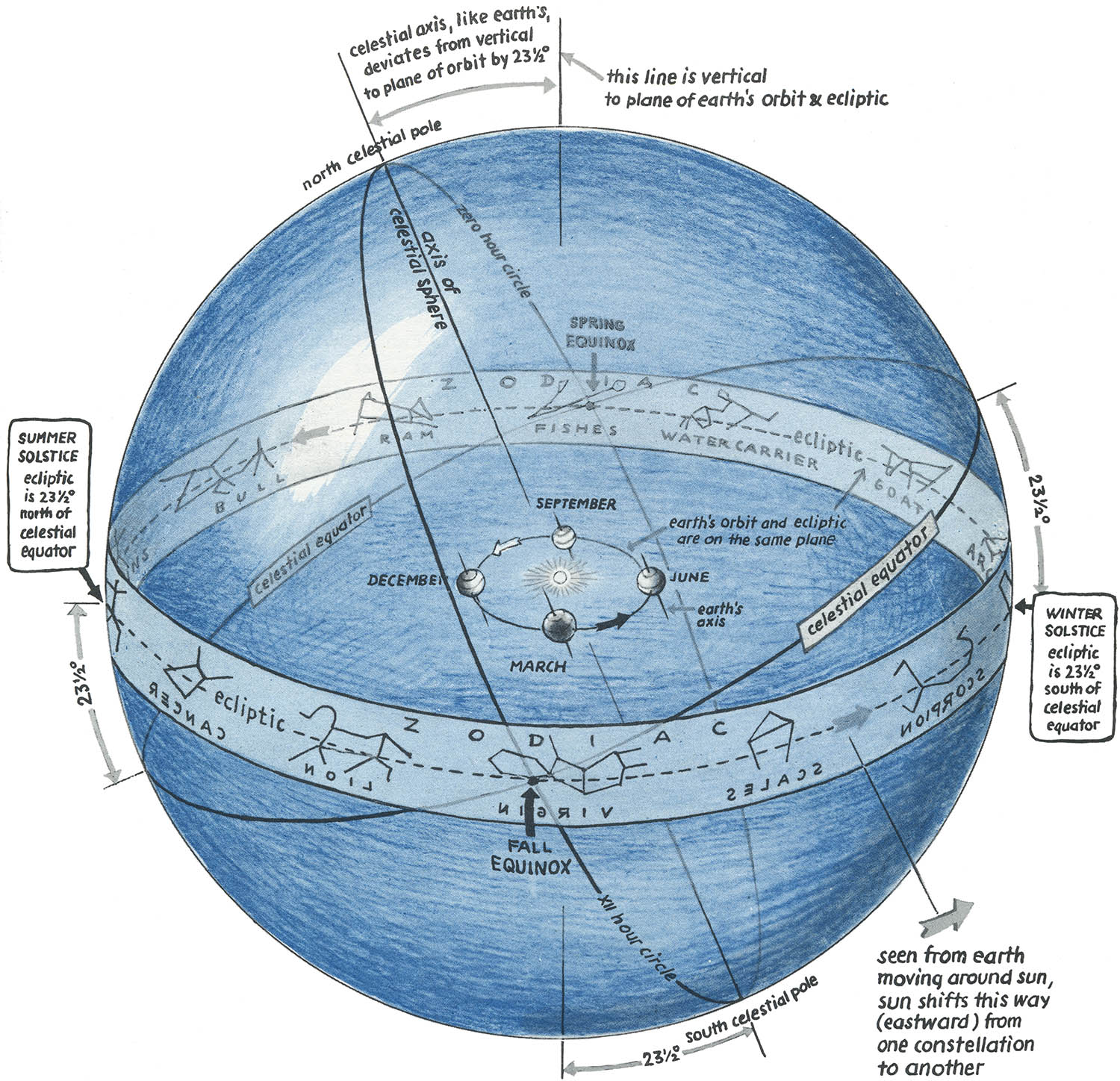
The Celestial sphere
In 1954 he published a simplified children’s title Find the Constellations,3 a book that he famously quipped “...was so simple even an adult could understand it.” Like The Stars, it is now a classic.
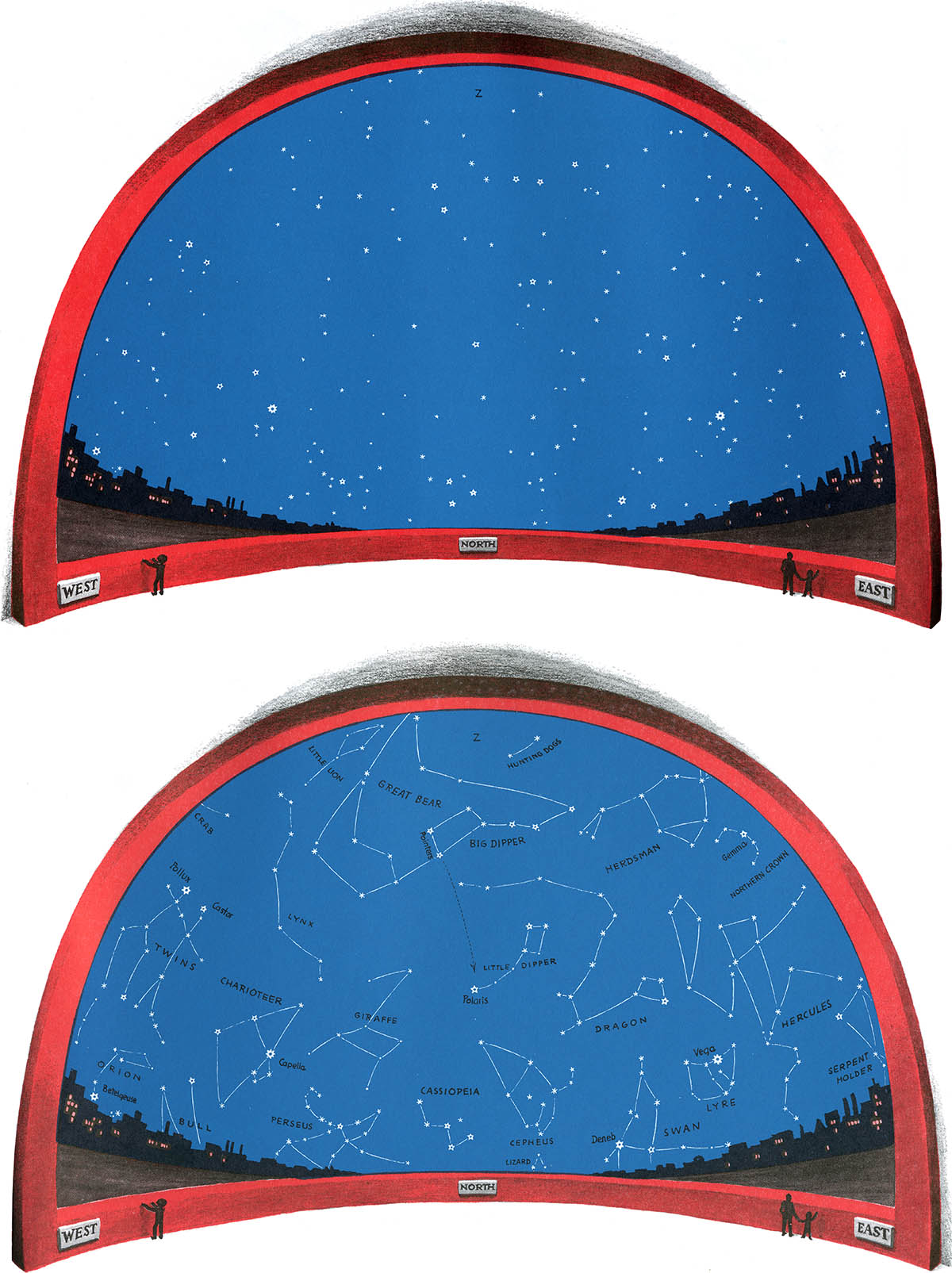
Calendar chart
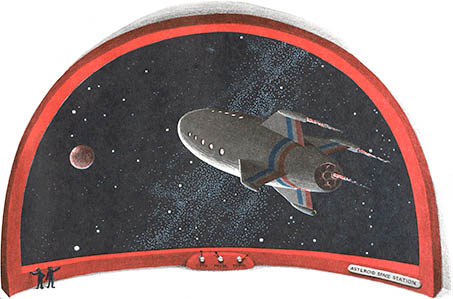
Space Ship Approaching Mars
1. Margaret’s formal art training included study at the Bauhaus in Dessau in 1927 (when both Klee and Kandinsky were on faculty) and the Dusseldorf Academy of Arts in 1928—1929.
2. Rey, H. A. The Stars: A New Way to See Them. Boston: Houghton Mifflin, 1952 (WorldCat). The book has been updated and reprinted several times over the years. The current 2008 edition, updated by Fritz Eichenberg, includes planetary tables good through 2016. Early editions included a dust jacket that folded out into a wall-sized (22 × 26") star chart which could be purchased separately from the publisher. Later hardcover editions even included instructions on turning the dust jacket into a planisphere.
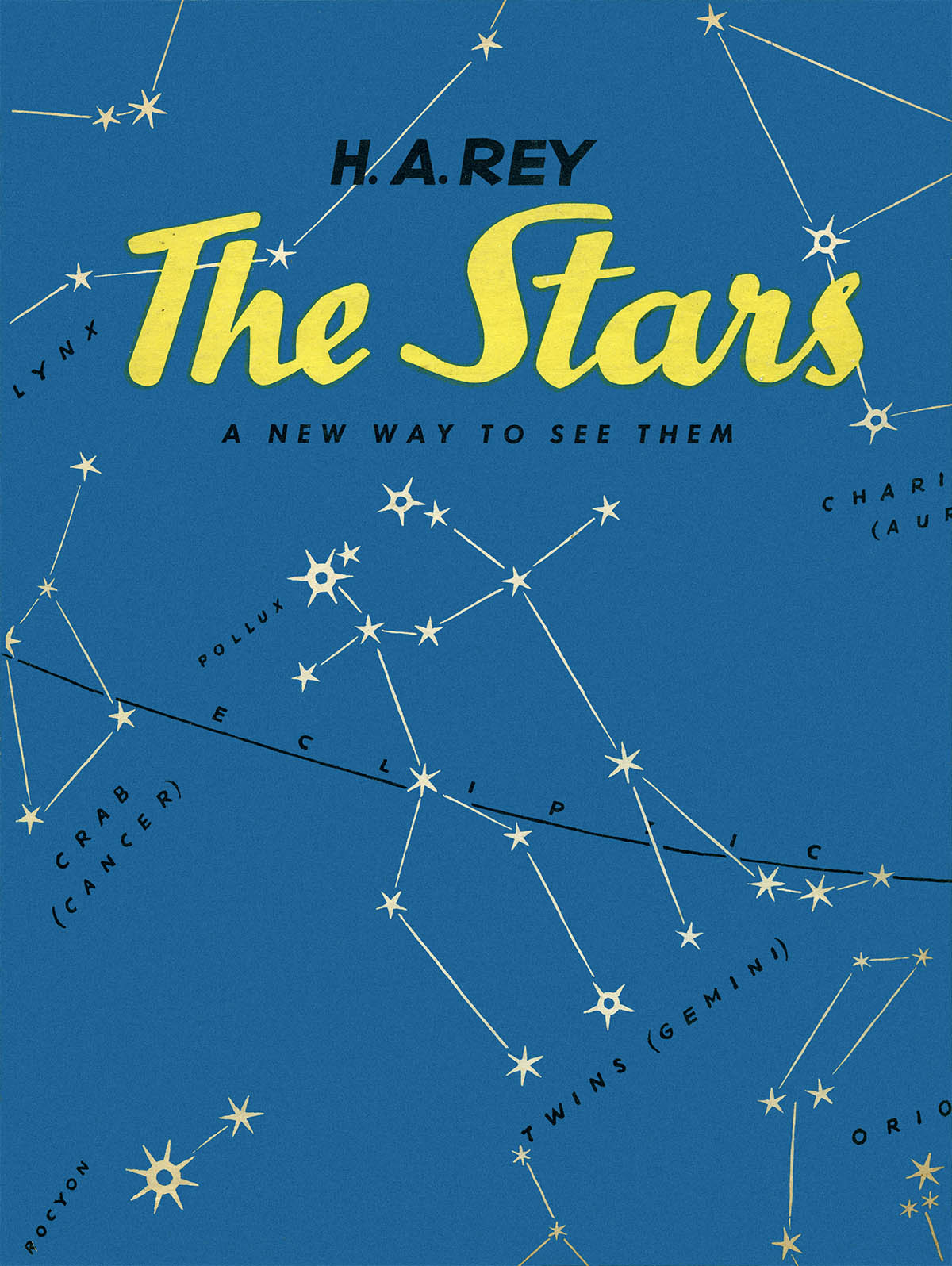
3. Rey, H. A. Find the Constellations. Boston: Houghton Mifflin, 1954 (WorldCat). Like The Stars, this title has been updated several times.
11 Apr 2009, updated 12 Aug 2015 ‧ Illustration