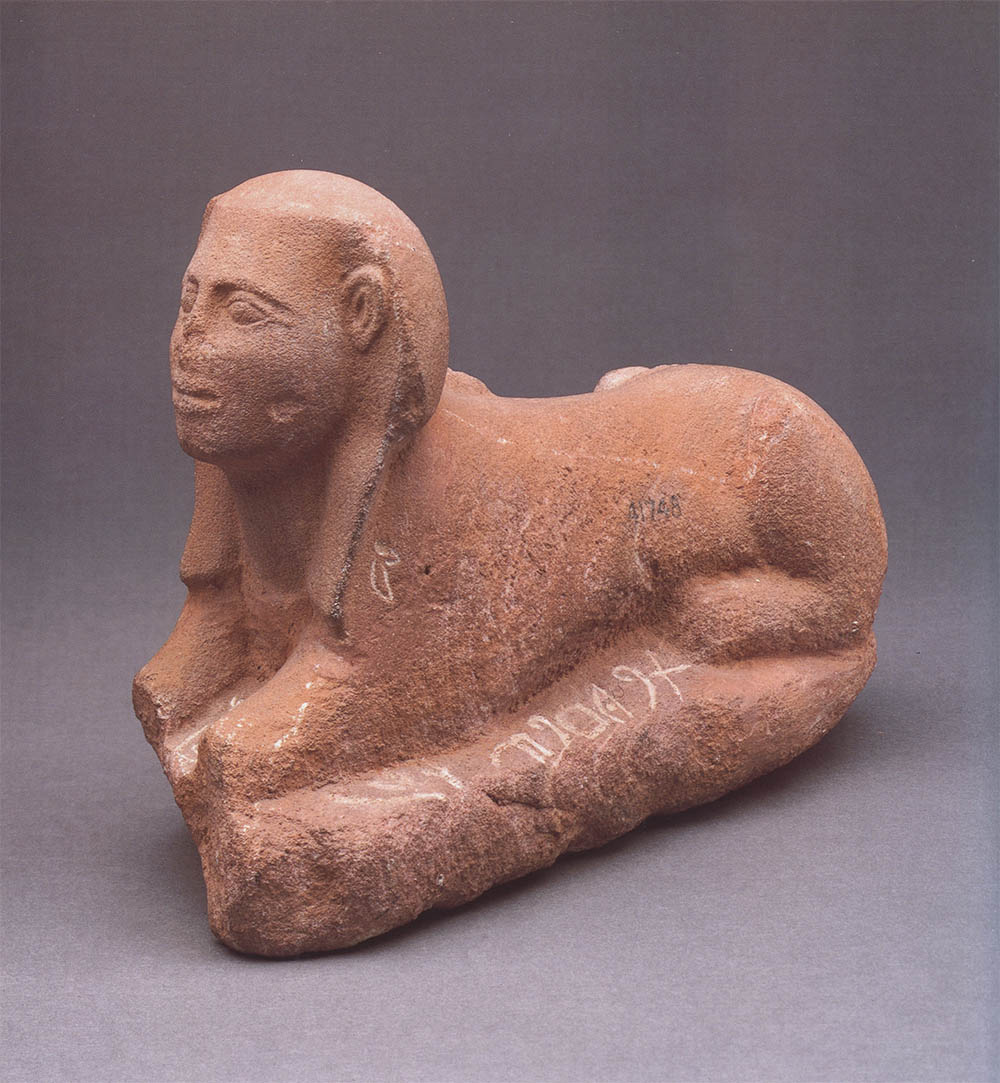
From ref. 1
11
The Serabit el-Khadim Sphinx
Proto-Sinaitic
This red sandstone sphinx, ca.1800 BC, was discovered in 1904–1905 by Sir William Flinders Petrie in the temple ruins at Serabit el-Khadim, a copper and turquoise mining area on the West coast on the Sinai peninsula. The sphinx appears to be a votive to the Hathor, the goddess associated with turquoise. It is inscribed both in crude hieroglyphic and proto-sinaitic.
The hieroglyphs read “Beloved of Hathor [Mistress] of turquoise” and the proto-sinaitic, deciphered by Sir Alan Gardiner in 1916, reads b’lt (or b’alat “to the Lady” – a title of Hathor).2 This is as close to a Rosetta Stone of Proto-Sinaitic as you are going to get.
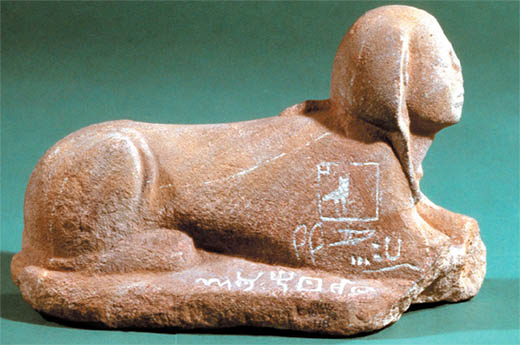
The origins of the present-day alphabet can be traced back to the hieroglyphs, but this first jump is admittedly somewhat speculative. Around 1900 BC the Proto-Sinaitic script began to appear in Egypt, the Sinai and the Levant. Sir Alan Gardiner, after deciphering the sphinx inscription, suggested that the script was an acrophonical “alphabet”3 derived from hieratic or hieroglyphic signs. It was commonly believed that it was developed by the Semitic-speaking peoples of the Sinai and Levant.
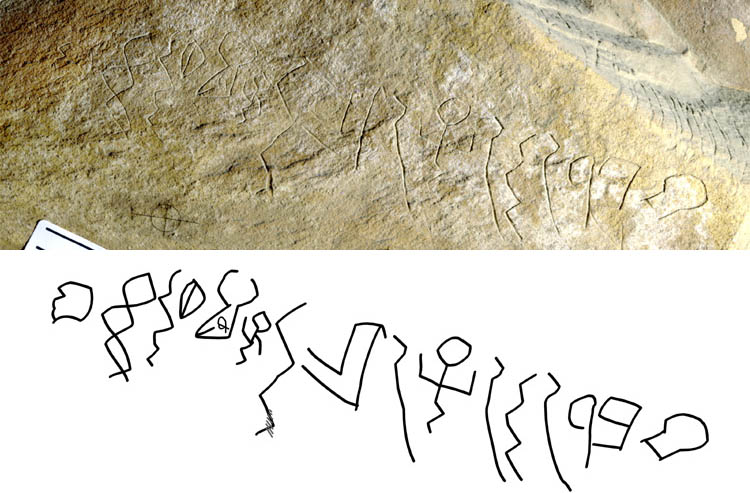
Wadi al-Hol inscription 1, ca.1900 BC. WSRP
In 1999 the Yale researchers, John and Deborah Darnell, found several Proto-Sinaitic inscriptions at Wadi al-Hol in Egypt. The discovery in a remote part of Egypt, in addition to causing a general stir in archeological circles, also allowed them to develop a different hypothesis on the script’s origin. They suggest that the language was not developed by the Semites (or Asiatics, as the Egyptians called them) but was invented by Egyptian scribes and bureaucrats to allow them to communicate with these Asiatics, who at times were slaves, mercenaries or trading partners with Egypt.4 A kind of pidgin Egyptian.
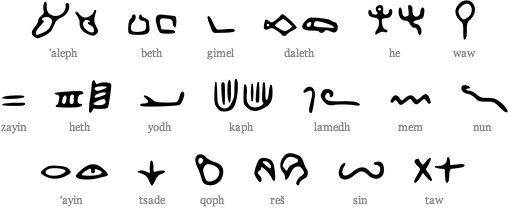
Proto-Sinaitic consists of roughly 19 or so signs that can be, at least theoretically, associated with hieroglyphic or hieratic signs. Whatever the mysterious origins the script, it eventually spread East throughout the Sinai and the Levant and was adopted by the Canaanites (hence it’s other names: Proto-Canaanite or Old Canaanite) and later by the Phoenicians.
1. Parkinson, Richard. Cracking Codes: The Rosetta Stone and Decipherment. Berkeley: University of California Press, 1999.
2. Gardiner, Sir Alan H. The Egyptian Origin of the Semitic Alphabet. Journal of Egyptian Archaeology, 1916 3: 1-16. After a century of research this single phrase is still the only one deciphered.
3. The language consisted of only consonants, vowels had to be supplied by the speaker, so the script is technically an abjad.
4. Darnell J., Dobbs-Allsopp, C., et al., “Two Early Alphabetic Inscriptions from the Wadi el-Hol: New Evidence for the Origin of the Alphabet from the Western Desert of Egypt.” Annual of the American Schools of Oriental Research. 2005.
5 Jan 2009, updated 26 Dec 2011 ‧ Typographia Historia