2
The Temple of Mentuhotep II
The Hieroglyphs
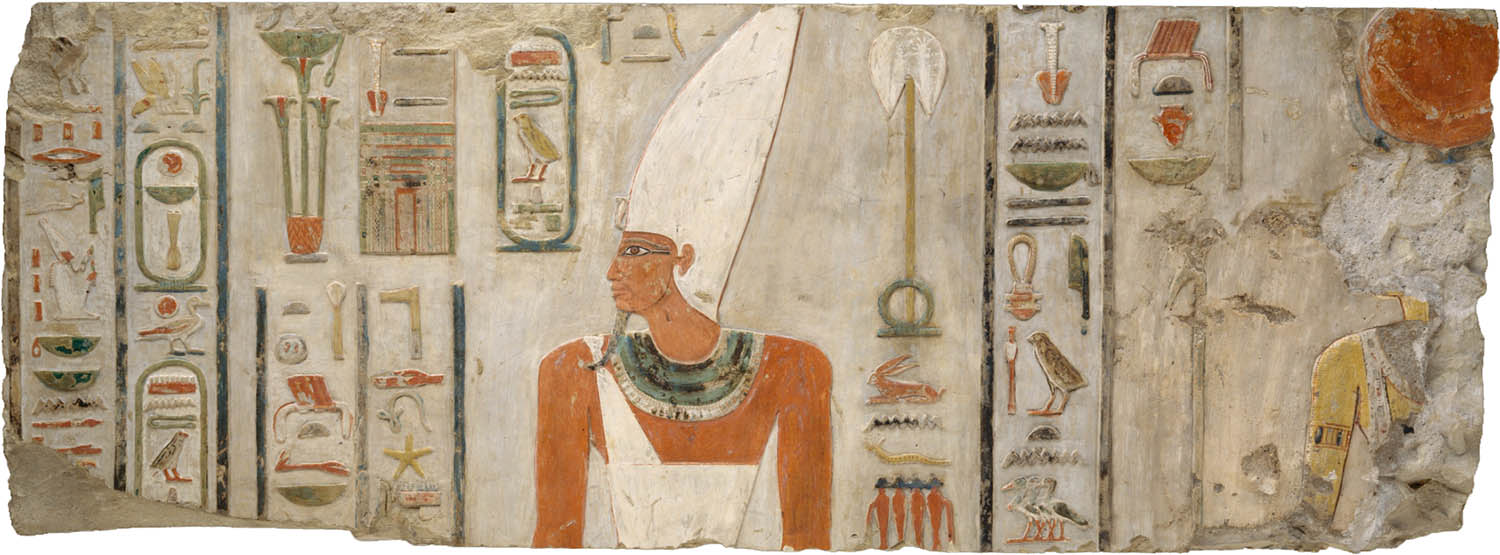
This painted limestone relief from the tomb of Nebhepetre Mentuhotep II dates to about 2000 BC.1 It was discovered in 1907 by Herbert Winlock during one of his early expeditions sponsored by the Metropolitan Museum of Art, where it is now on display.
Mentuhotep II, an 11th dynasty ruler, built an unusual terraced mortuary complex at Deir el-Bahri during his reign, and much of the complex was decorated with these limestone reliefs. This example, showing Mentuhotep as a god in the afterlife includes his name in the cartuoche. It is a good example of formal hieroglyphic and clearly shows the skills of the royal workshops.
Writing in the Nile River Delta appeared around the beginning of the First Dynasty, ca.3200 BC Unlike Sumerian cuneiform, however, the origin of the hieroglyphs are not well understood, but early examples, such as the Abydos tags or the Narmer palette, are clearly based on artistic traditions. Over the next three millennia hieroglyphs would appear everywhere: as temple wall lapidary, on faience statues, on alabaster canopic jars (my personal favorite) and papyrus Books of the Dead – on pretty much everything.2 The Egyptian artisans and scribes saw little difference between text and illustration.
The formal script grew from some 750 or so signs to a few thousand by the Ptolemiac period. By 600 bc the cursive version of the hierogpyphs – hieratic – had evolved into demotic, which shows almost no trace of its hieroglyphic roots. Demotic was eventually replaced by Greek, then Latin, and by about 300 bc all knowledge of the hieroglyphs had been lost, even among the Egyptians.
It is no surprise then, that by the time of Alexander's conquest of Egypt in 332 BC, the Greeks thought they were magical symbols and gave them the name hieroglyphiká.3 These strange symbols captivated the Greeks and ca.500 AD Horapollo wrote Hieroglyphia, the first authoritative text on the subject. After Hieroglyphia was discovered again in the middle ages it became widely influential with the 15th century Humanists. Colonna included hieroglyphs in the Hypnerotomachia Poliphili (1499) and Athanasius Kircher published his own study in his massive 3-volume Oedipus Aegyptiacus (1652) The only problem was that Heiroglyphia was completely wrong. It would take the discovery of the Rosetta Stone, some 200 years later, before there was a proper decipherment.
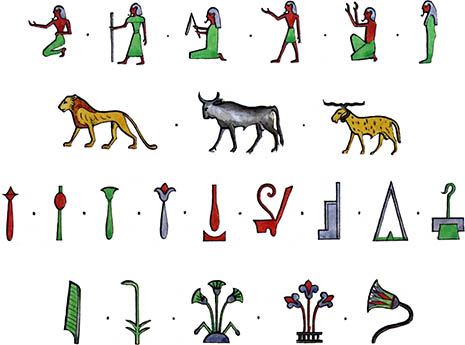
Hieroglyphic examples from Champollion’s Grammiare4
The Rosetta Stone, a stele written in hieroglyphic, demotic and Greek was discovered in 1798 by French archeologists after Napoleon conquered Egypt. Almost immediately experts began to decipher the hieroglyphic signs. The English polymath Thomas Young attempted the translation with the help of a partial demotic alphabet but it would be the French Egyptologist and polyglot Jean-François Champollion who would unlock the secrets of the magical Egyptian symbols. He detailed his translation and key to Egyptian grammar in his now famous Lettre a M. Dacier5 and Précis du système hiéroglyphique,6 and found hieroglyphic to be “a complex system, writing figurative, symbolic, and phonetic all at once, in the same text, the same phrase, I would almost say in the same word.”
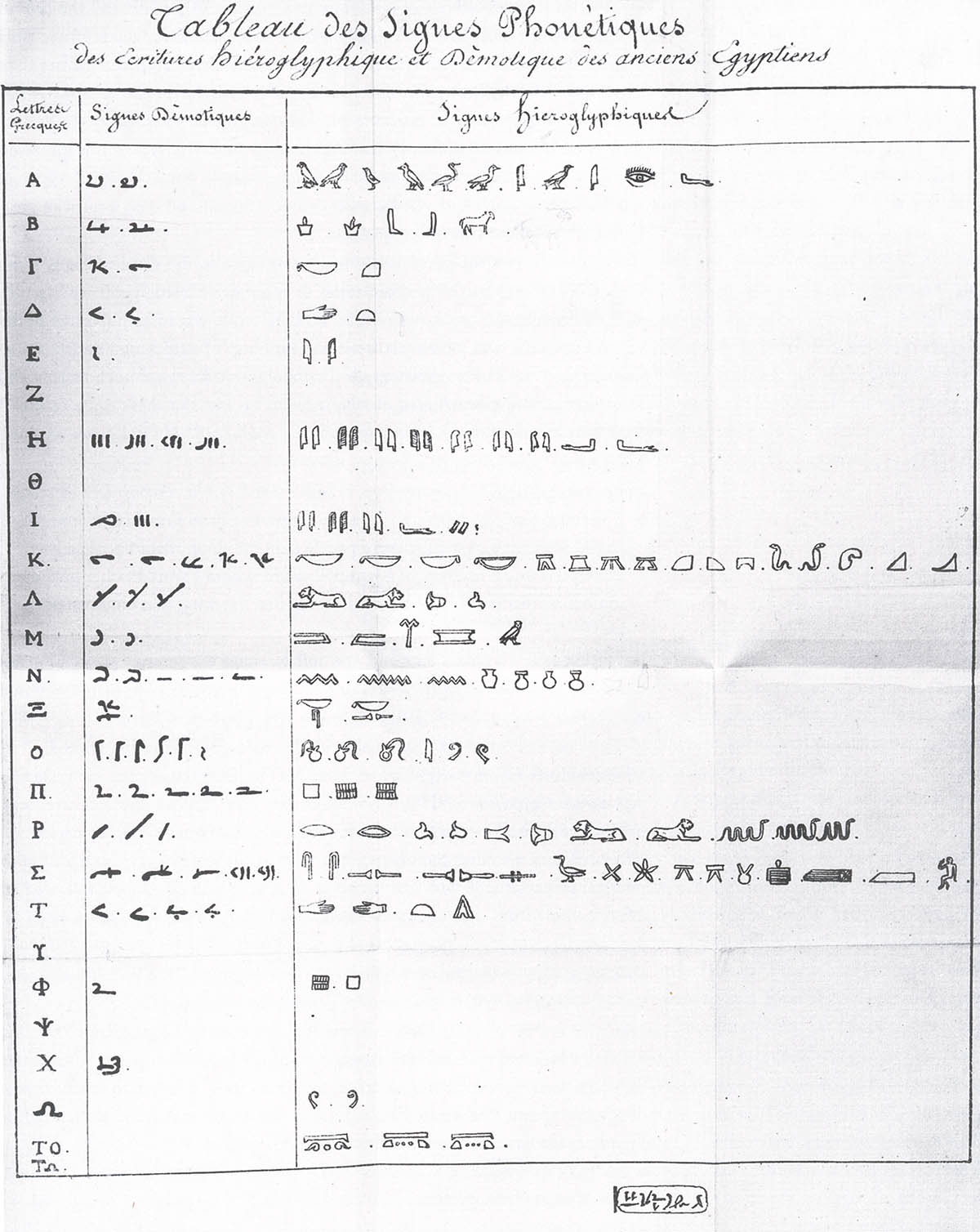
Champollion’s famous fold-out from Lettre
1. Nebhepetre Mentuhotep II (ca.2055–2004 BC) was the only son of the Theban ruler Intef III and his wife, the minor queen Iah. His rule, according to the Turin King List, lasted 51 years. In the 14th year of his reign he repelled the advances of the Heracleopolitan king Kheti and succeeded in reunifying Egypt after 150 years of provincial rule, becoming the first pharaoh of the Middle Kingdom. He also lead military operations against the Nubians to the south.
His principal wife was his sister Neferu II. Other wives included Tem, the mother of his first-born son Mentuhotep III (who succeeded him as pharaoh), Henhenet, who apparently died in child-birth, and Ashayet. Lesser wives and royal companions, some of which may have been Nubian conquests, included Kawit, Kemsit and Sadhe. His royal ladies and concubines included Amunet, Ment, Ten-net and As.
2. E.g.: of the 110,000+ Egyptian items in the British Museum 30% of them are inscribed with hieroglyphs.
3. ἱερογλυφικά (hieroglyphiká) from ἱερός hierós (’sacred’) and γλύφω glýphō (‘engrave’).
4. Champollion le Jeune. Grammaire Egyptienne. Paris: Typographie de Firmin Didot Frères, 1836.
5. Champollion le Jeune. Lettre à M. Dacier relative à l'alphabet des hiéroglyphes phonétiques. Paris: Chez Firmin Didot Pére Fils, 1822. A copy is online at Gallica.
6. Champollion le Jeune. Précis du système hiéroglyphique des anciens Égyptiens. Paris: L’Imprimerie royale, 1824. The second edition (1828) is available at Gallica.
18 Dec 2008, updated 27 Dec 2011 ‧ Typographia Historia