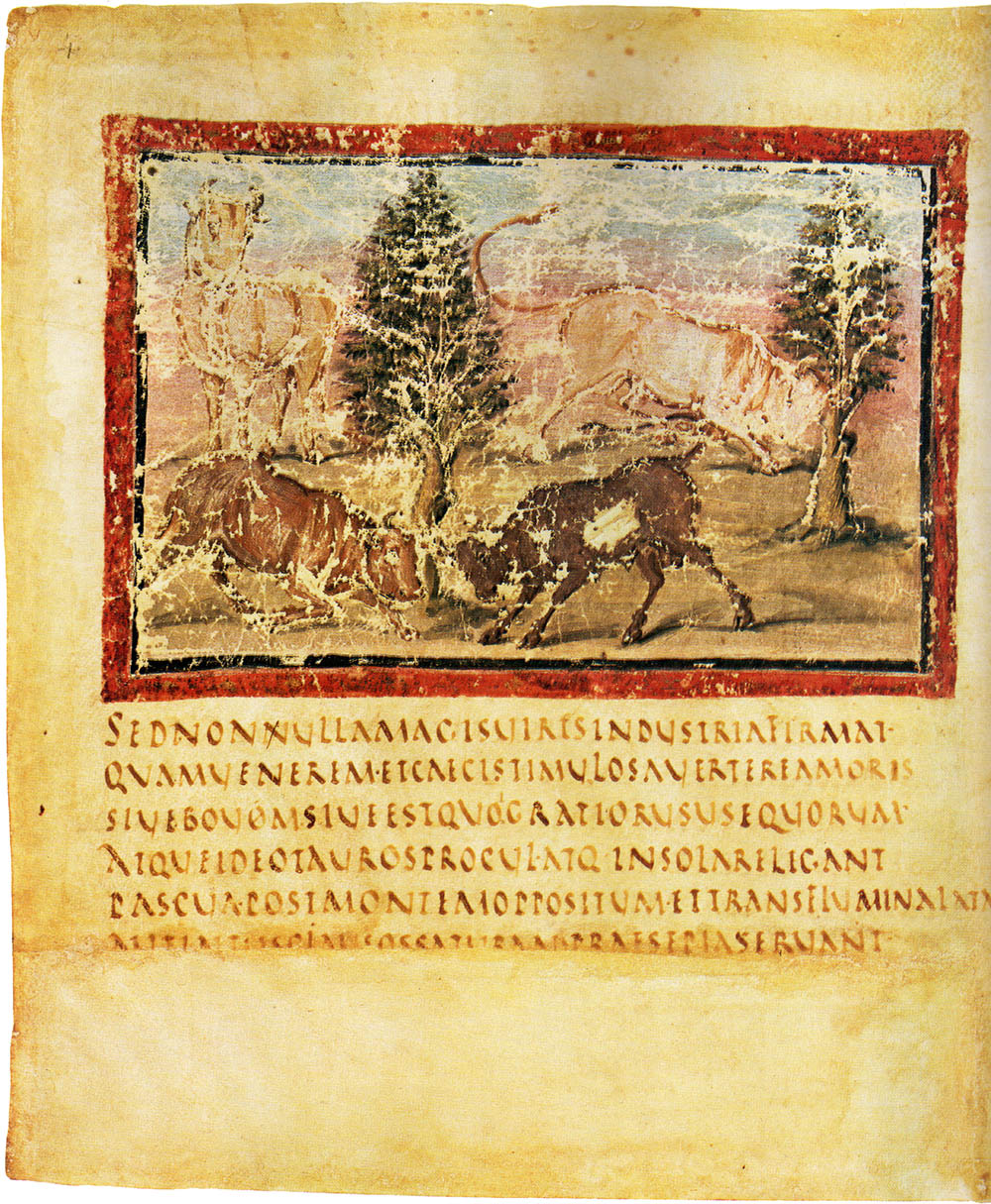
Folio 4v (Georg. 3.219–34)
32
Vergilius Vaticanus
Capitalis Rustica
This illuminated vellum page, showing the rivalry of two bulls over a beautiful cow from Vergil’s1 Georgics, is from the Vergilius Vaticanus (Biblioteca Apostolica, Cod. Vat. lat. 3225) and dates to about 400 AD.2 The 76 surviving leaves, written in capitalis rustica by a single scribe and illuminated by three artists, includes portions of Vergil’s Georgics and the Aeneid. It is one of the oldest known sources of Virgil and one of only a handful of early illuminated secular titles.3
The Vergilius Vacticanus was most likely written and illustrated in Rome and was probably commissioned as a de luxe edition by a pagan nobleman (perhaps a roman senator?). Based on annotations to the text it appears to have remained in Italy until at least the seventh century and by ca.850 was at the monastery of Saint-Martin in Tours where it was studied by the Carolingian artists. By ca.900 it had fallen out of use and was dismembered but, based on scribal annotations, remained in France as late as 1400. The remaining leaves turned up in Rome in 1514 where they were studied by Raphael and his circle. They were acquired by Pietro Bembo in 1521 and sold by his son Torquato to Fulvio Orsini in 1579. Orsini bequeathed them to the Biblioteca Apostolica in 1600.
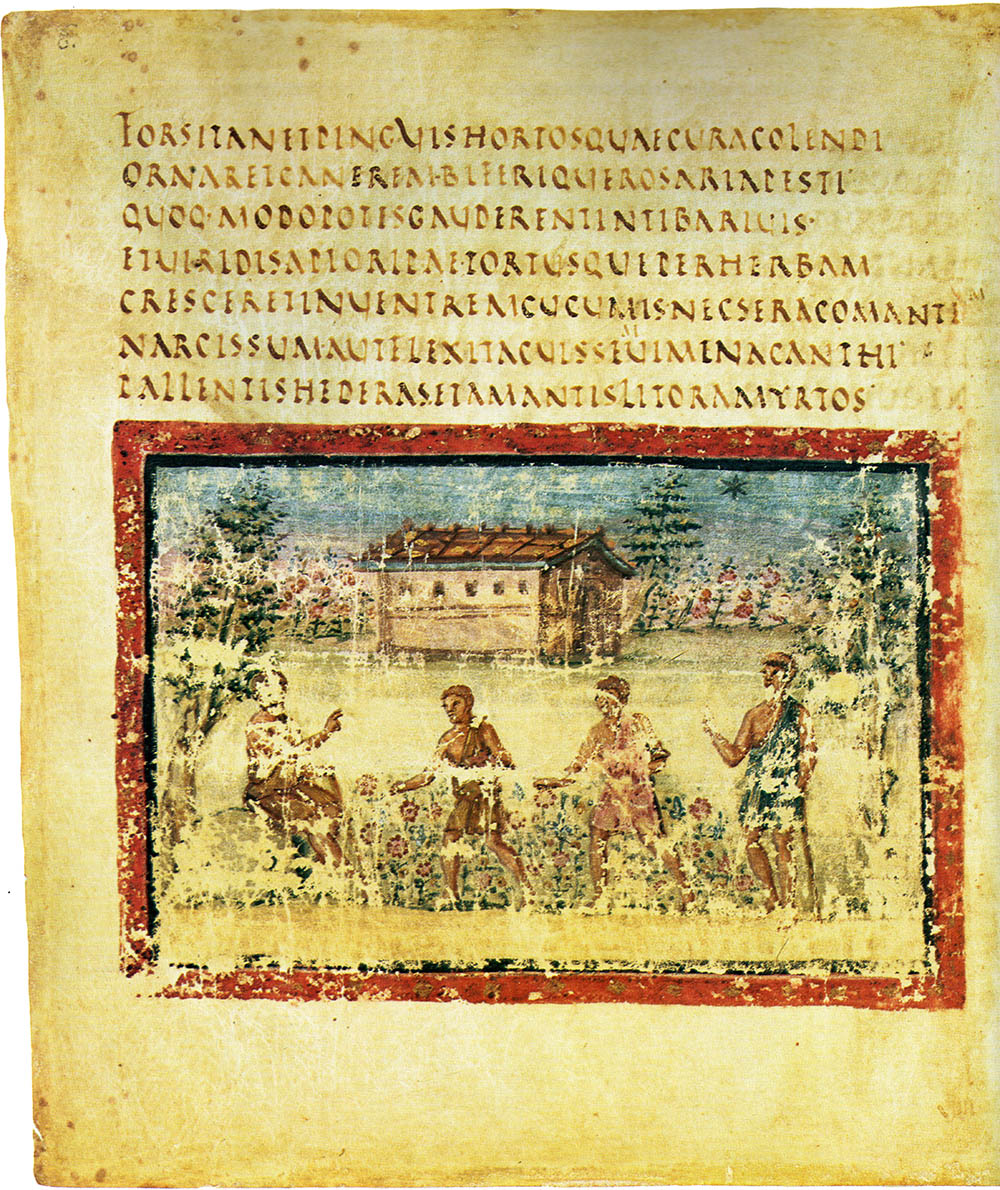
Folio 7v. The old man from Corycus (Georg. 4.125–46)
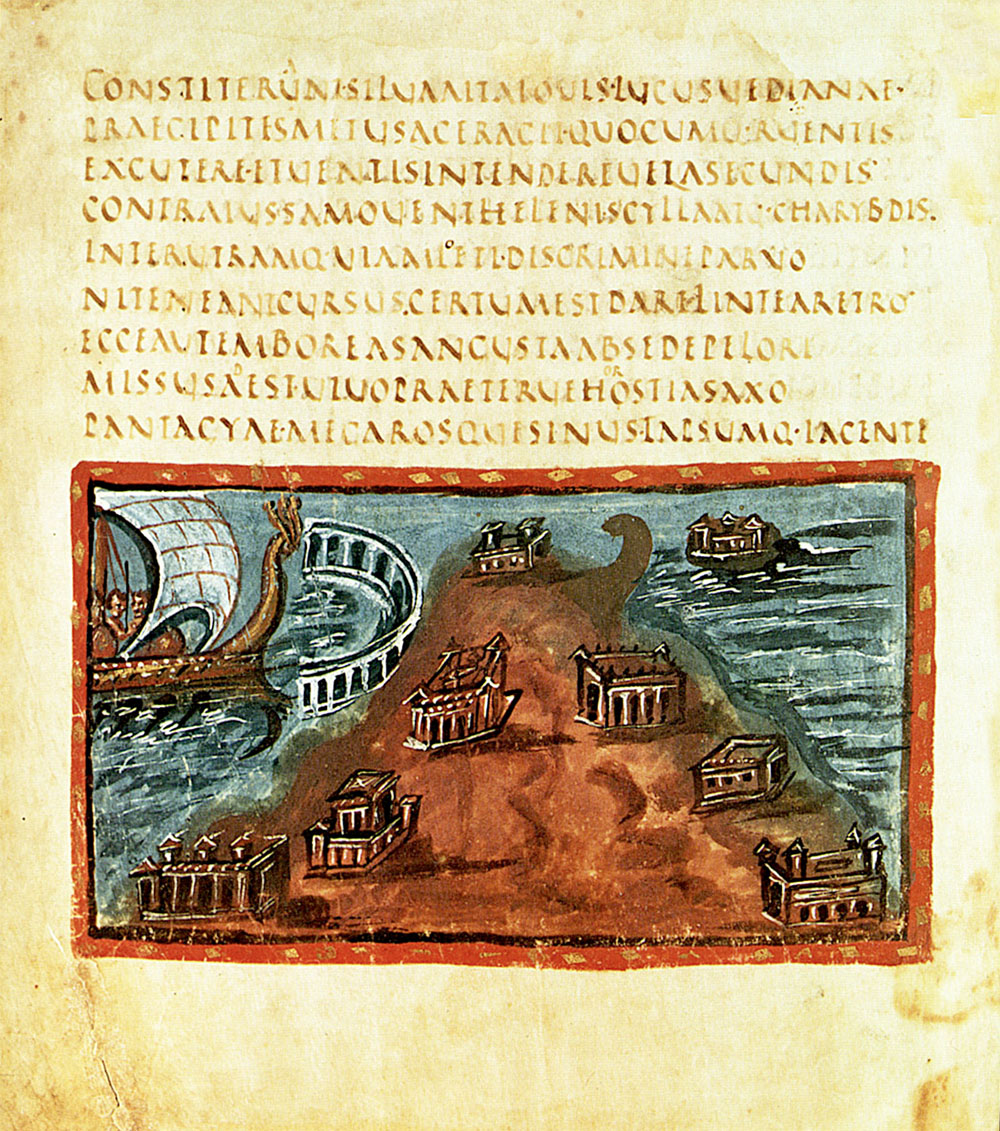
Folio 31v. Aeneas lands at Drepanum (Aen. 3.692–708)
Latin paleography after the capitalis monumentalis (which was covered here) evolved into essentially two different scripts; an informal cursive hand typically used on administrative documents and a more formal square capital hand, used for books.
The first of the square capital forms was the capitalis quadrata (or capitalis elegans). The characters, nearly geometrically square, show a strong modulation of stroke width and include pronounced terminal serifs. The script, however, was difficult to write, requiring a rather significant degree of quill nib manipulation.
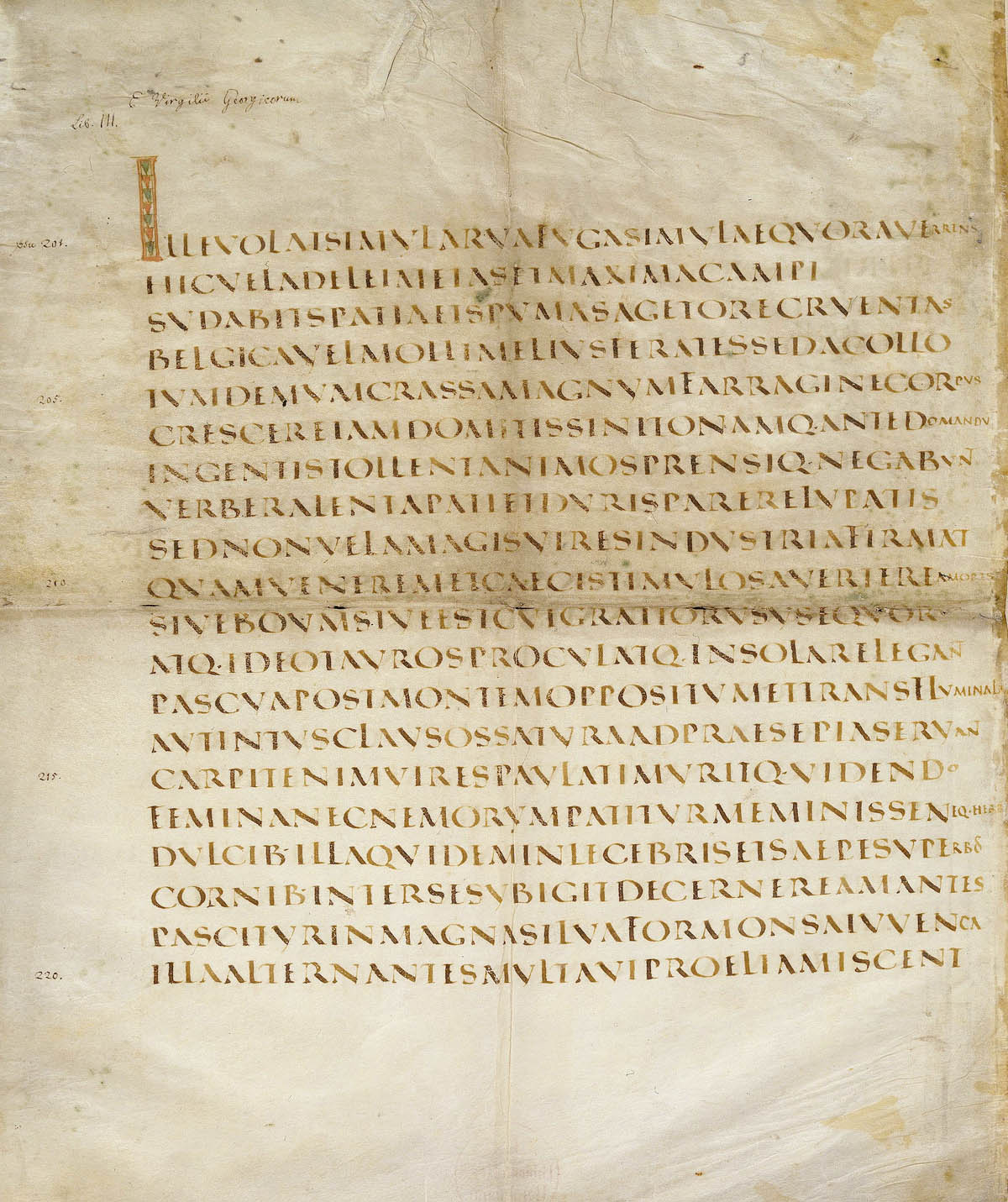
The Vergilius Augusteus, before 400
Capitalis rustica (or canonical capitalis) evolved from the quadrata as an simpler, and quicker hand. It was written with a strong, consistent slant with a nearly vertical quill nib. The resulting characters are taller than they are wide (although not approaching the magically delicious geometry of the capitalis monumentalis) and show a fair degree of modulation between strokes.
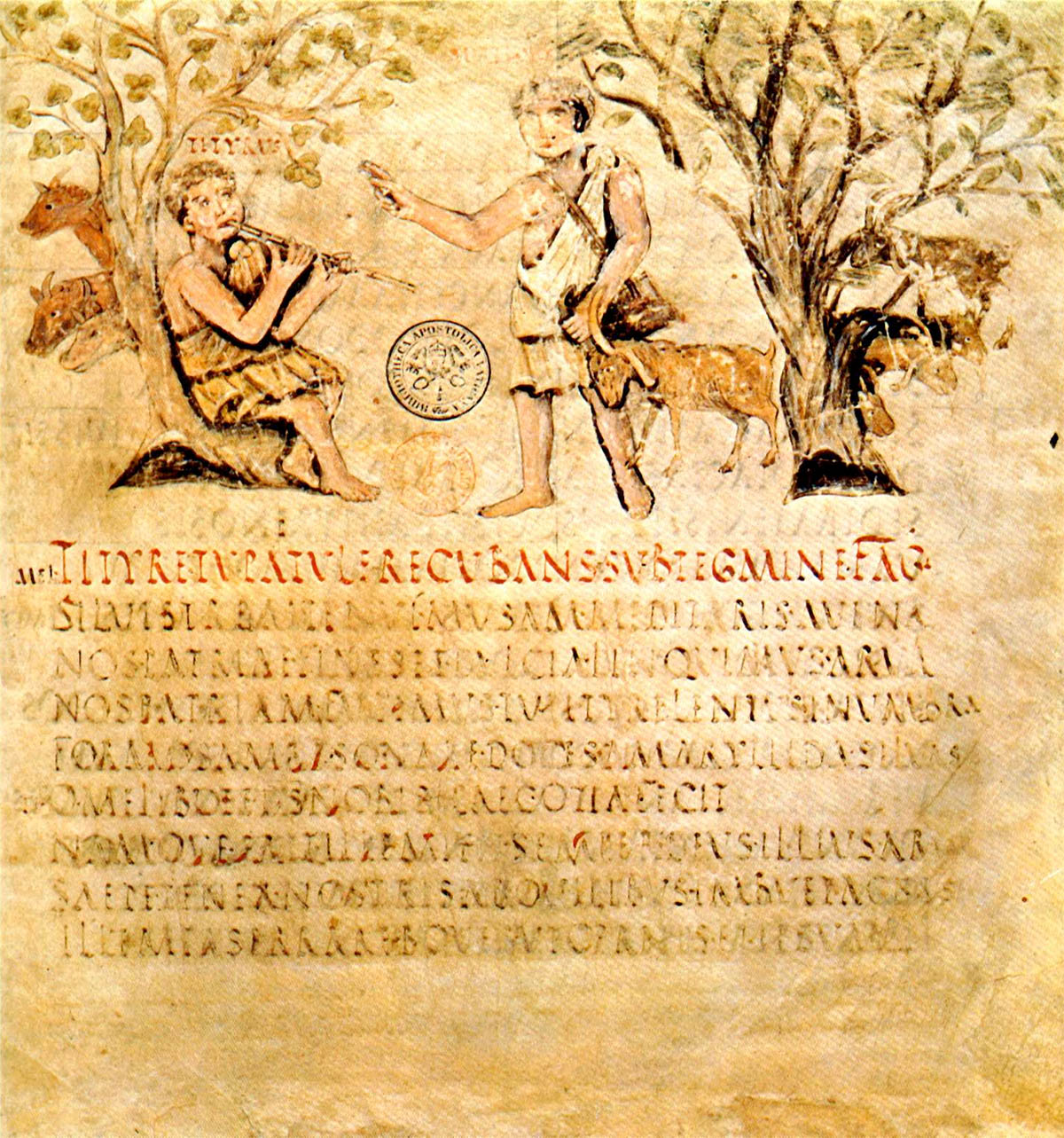
The Vergilius Romanus, ca.475
Finally, the uncial forms evolved from the rustica as an even simpler and quicker hand.
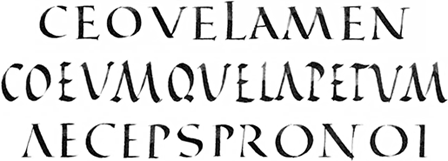
Calligraphic examples of quadrata (top), rustica and uncial (bottom). From ref.4
1. Publius Vergilius Maro, AKA Vergil or Virgil (October 15 Oct 70―21 Sept 19 BC), was the most famous of the classical Roman poets. He is best known for three major works; Eclogae (the Eclogues) (ca.42―39 BC), Georgicon (the Georgics) (29 BC) and the epic Aeneis (Aeneid) (29―19 BC). His works, considered staples of the classics canon, are widely available online. For one very good presentation see: the Perseus digital Library.
2. For a detailed analysis and history of the book see: Herndon Wright, David. The Vatican Vergil: a masterpiece of late antique art. Berekley: University of California Press, 1993, which is mostly available online at Google Books.
3. For a complete overview of Latin paleography see: Bischoff, Bernhard, Crónín, Dáihbí (trans.) Latin Paleography: Antiquity and the Middle Ages. Cambridge: Cambridge University Press, 1991.
21 Jun 2009, updated 26 Dec 2011 ‧ Typographia Historia